A narrow London street at late afternoon with a guitar resting in a music shop window recess

Fretwork Guitar Studio · Denmark Street, London

Lesson formats and learning paths that fit how you play

Choosing a lesson format is mostly about your week, not your talent. Here is how the studio teaches, what changes between beginner and intermediate material, and how to tell which route suits you.

Start here

Nothing is fixed until we have spoken

Formats can be mixed across a term. Some learners take private lessons for a month, then join a group once their hands know where to go. Others stay one-to-one the whole way because their goal is a specific exam or a set of songs. Both are normal, and neither is a failure of commitment.

Send an enquiry with four things and we can put a plan in front of you: your instrument, roughly how long you have played, what you want to be able to play, and when you are actually free during the week. The studio replies directly to every enquiry — there is no booking system to fight with and no form that vanishes into a queue.

What helps us plan

  • Your instrument. Acoustic, electric, or both. Classical if that is what you own — it changes what we cover first.

  • How long you have played. Weeks, years, or a decade ago in a school music room. Returning players are welcome.

  • What you want out of it. A song, a grade, playing with friends, or improvising. Aim at something concrete.

  • When you are free. Evenings, Saturday mornings, fortnightly blocks. Tell us the awkward truth about your week.

The short version

Pick the format by your week, then let the material follow your instrument and your goal.

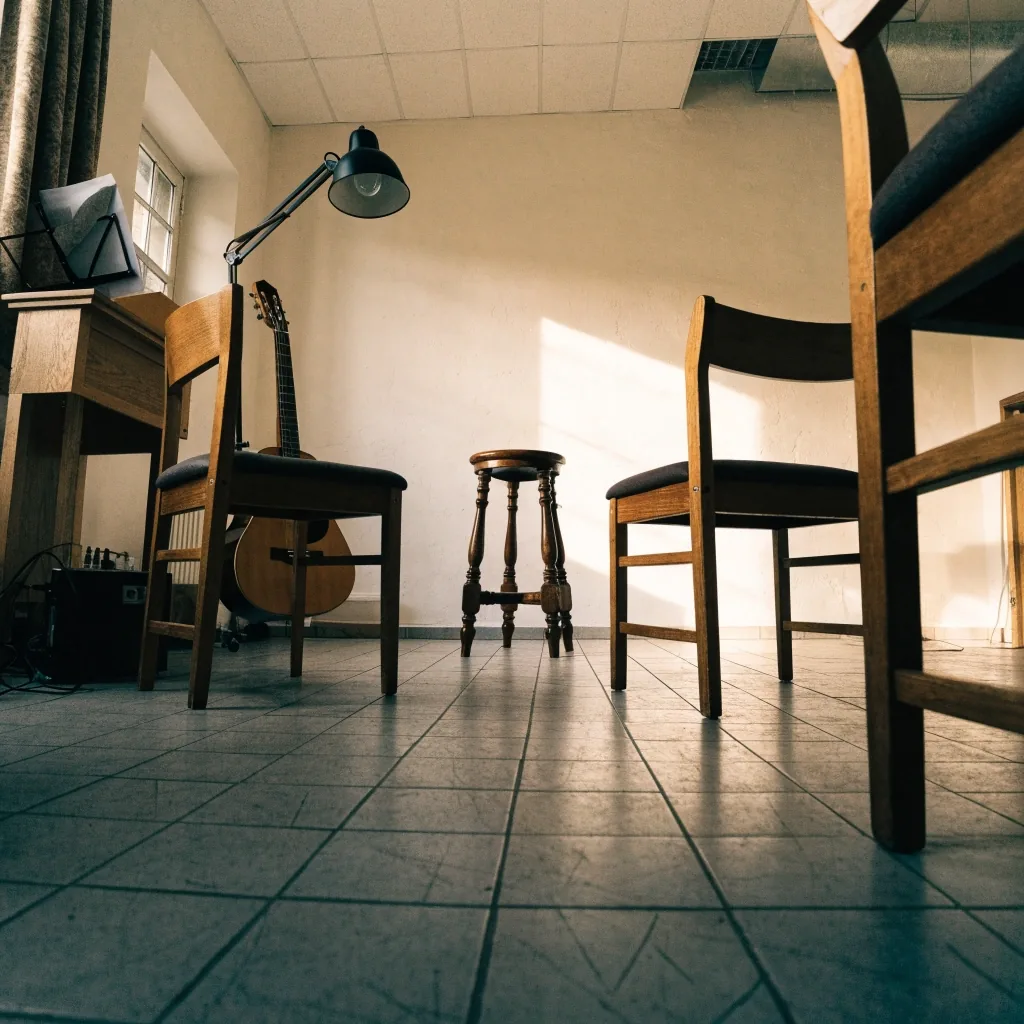
A low wide view of a teaching room with three chairs in an arc and a guitar propped against a music stand

One-to-one, small group, or online

Three routes, three different weeks. Most learners start on the left and move right as their confidence settles — or stay exactly where they are, which is fine too.

One-to-one lessons

A private tutor sees everything: your fretting hand tension, your pick angle, the way you rush the chord change you find hardest. Sessions run to your material and your pace, which matters most in the first few months when small corrections prevent habits that take a year to undo.

Good fit for exam preparation, audition work, and anyone whose goals do not match a group. It is also the format most returning players choose, because a teacher can quickly find what has survived the years away.

Best for: exams, audition prep, returning players
Small group lessons

Groups of three to five learners work when everyone is at a similar stage, and they add something a private lesson cannot: playing with other people. Keeping time with another guitarist exposes timing problems faster than any metronome exercise.

Groups run by level and by interest, so a rock-focused beginner group and an acoustic song group cover different material. If you learn better with company and a bit of friendly pressure, say so in your enquiry.

Best for: ensemble playing, momentum, budget spread

Online guitar lessons

Online sessions use the same teaching as studio lessons, with the camera positioned so your fretboard is visible. Chord shapes, strumming patterns, fingerpicking, tablature, and music theory all work in this format.

Slight audio delay means we avoid fast unison playing and use call-and-response instead, which is arguably better for your ear anyway. You need a phone or laptop, a reasonably stable connection, and a quiet corner.

Best for: shift work, parents, long journeys

Two learning paths: acoustic and electric

The instrument you bring changes what gets taught first. Neither route is easier — they simply reward different things early on.

An acoustic guitar lying flat on a dark wooden table with a capo beside the neck in soft window light

Acoustic guitar path

Songs that carry themselves without a band

Acoustic players usually start with open chord shapes, strumming patterns, and songs built around the voice. From there the path moves into fingerpicking, bass-note walking, and dynamics, which is where acoustic playing gets interesting.

Strumming and singing at the same time is its own skill, and we work on it deliberately rather than hoping it clicks. Most learners reach a recognisable song within the first few weeks and then spend months making it sound deliberate.

Electric guitar path

Riffs, bends, and lead lines early

Electric playing opens up power chords, riffs, bends, and lead lines early, which is why beginners often find it more immediately rewarding. The path runs through palm muting, picking accuracy, pentatonic shapes, and eventually improvisation over a backing track.

Amplifier settings and tone get covered because they shape what you hear and how you respond to it. If you already own an electric guitar and a small amp, you have everything needed to start.

Not sure which suits you? Bring the guitar you own to the first session. The plan is written around that, not around a recommendation to buy something new.

Graded exam routes

Milestones, if you want them

Learners who want formal milestones can work towards graded exams. Exam preparation changes the shape of lessons: set pieces, technical exercises, sight-reading, and aural work all need scheduled time.

Tell us the grade and board in your enquiry so the plan reflects it from the first session rather than two months in.

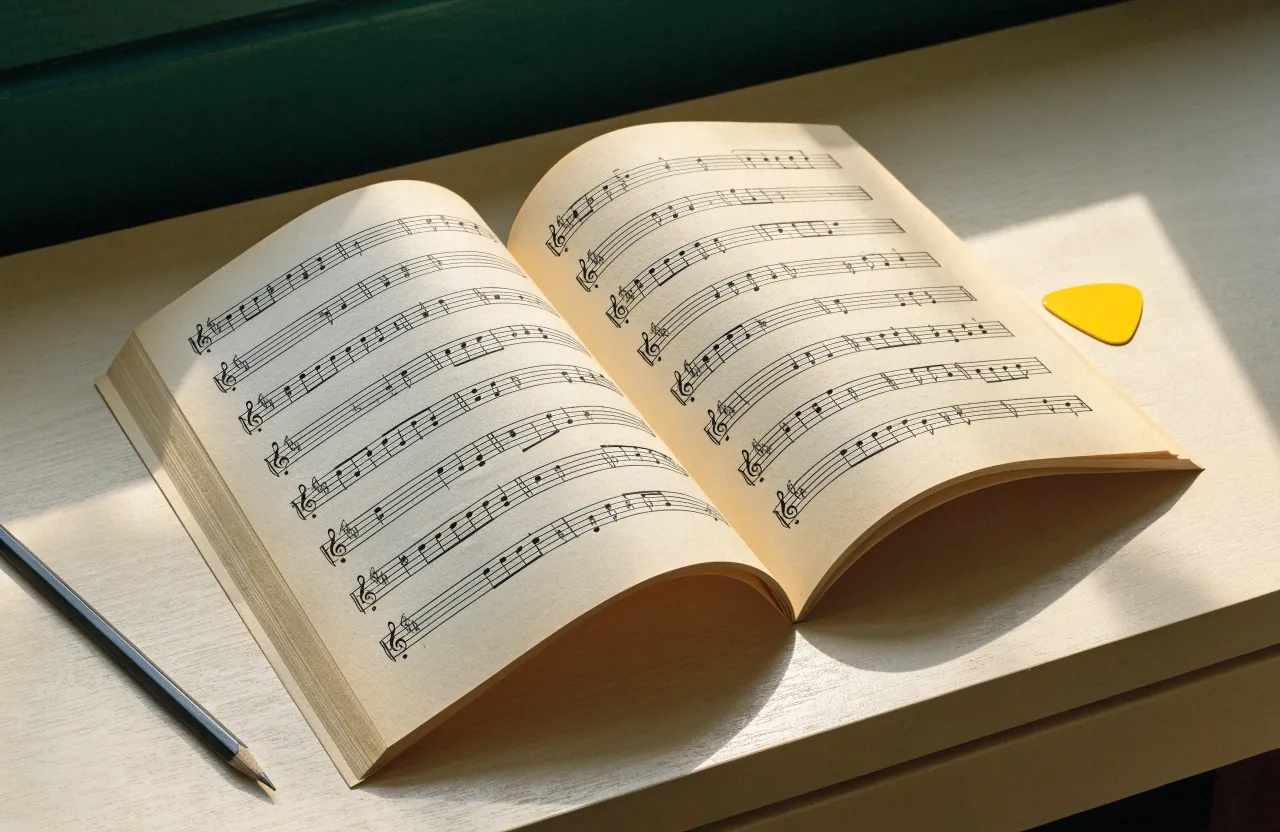
An open manuscript book with blank staves, a pencil and a yellow guitar pick on a pale wooden desk
Rockschool Guitar
A contemporary framework built around performance, musicianship, and technical skills, with material drawn from rock, pop, and related styles. Suits players who want their exam pieces to be songs they would play anyway.
ABRSM guitar exams
A more traditional graded route that many school-age learners and private students follow. Strong on reading, aural work, and structured progression, with a longer repertoire tradition behind it.
What preparation involves
Set pieces, scales and technical exercises, sight-reading, and aural tests. Each of those needs its own slot in the session, so exam terms run tighter than a term built around songs and repertoire alone.
If you would rather not
Plenty of learners never take an exam and still improve steadily. Grades are a route, not a requirement. Say what you actually want and the plan is built around that instead.

What changes as you progress

Lessons do not follow a fixed ladder. What changes is the balance between getting sound out of the instrument and using it with other people.

Early lessons

Getting sound out of the instrument and changing chords in time. Hand position, pick hold, and the first clean changes between two or three shapes.

Middle lessons

Repertoire, rhythm variety, and the theory that explains what you are already playing. This is where songs start sounding like the recording instead of an approximation.

Later lessons

Performance: playing with others, handling nerves, refining tone, and building a set you can actually get through in one go.

Some learners never move past the middle stage and are perfectly happy there, which is a legitimate place to be. The plan follows your goal, not a ladder.

Mixed and irregular schedules

Not everyone can hold the same slot every week. Mention your pattern in the enquiry and we will suggest something that survives contact with your calendar.

Fortnightly sessions

A longer gap between lessons means more material to cover each time. We set a clear practice target for the fortnight and review it at the next session instead of letting two weeks drift.

Block bookings

Book a run of sessions around a deadline instead of a rolling weekly slot. Useful before a performance, a school recital, or a return to playing after a long break away.

Intensive blocks

Suited to returning players who want a concentrated reset — several sessions close together to rebuild hand memory and iron out the habits that came back with you, then settle into a routine.

Choosing between formats

If you are not sure where to start, these four situations cover most of the enquiries the studio receives. Each one points to a sensible first term.

Never played before

Start with a private lesson for the first month to get your hands set up correctly, then a group can add the ensemble element once the basic changes are automatic. Doing it the other way round usually means unlearning something.

Returning after years away

Begin with one-to-one so a teacher can assess what has stuck. Most returning players keep more than they expect and lose the things that were never solid — knowing which is which saves months.

Travel is the obstacle

Go online. You lose very little — chord shapes, strumming patterns, fingerpicking, tablature, and theory all transfer cleanly. The camera is set so your fretboard stays visible, and call-and-response replaces fast unison playing.

You want to play with other people

Join a group early rather than treating it as a reward for reaching a certain level. Playing with another guitarist exposes timing problems faster than any exercise you can do alone.

Questions before you enquire

Short answers to the things learners ask most often while they are deciding. Anything else, ask it in the enquiry and you will get a straight reply.

Do I need my own guitar to start?

You do, mainly because practice between sessions is where the progress happens. If you have not bought one yet, bring what you are considering to the first session and we will tell you honestly whether it will carry you through the first year.

How long is a lesson, and how often?

That depends on the format and on your goal, so it is one of the first things we settle in the enquiry reply. Weekly sessions suit learners building a habit; fortnightly blocks suit tighter calendars. Nothing is fixed until we have spoken.

Can I switch format later?

Yes, and plenty of learners do. Formats can be mixed across a term — private lessons to sort out technique, a group for ensemble playing, online when the week gets difficult. Tell us it has changed and the plan changes with it.

What do I need for online lessons?

A phone or laptop, a reasonably stable connection, and a quiet corner where you can hear the guitar over the room. You will be asked to angle the camera so your fretboard is visible — after the first session it takes about ten seconds to set up.

How does the studio reply to an enquiry?

Directly, by phone or email, during studio hours. Monday to Friday, 9:00 AM – 6:00 PM, and Saturday, 10:00 AM – 4:00 PM. You will get a suggestion for a format, a first plan, and a question or two if anything in your message needs clarifying.

An empty guitar studio at dusk with a stool and music stand under a single warm lamp

Tell us your week and your goal

Send an enquiry with your instrument, how long you have played, what you want to be able to play, and when you are free. The studio replies directly during opening hours with a format suggestion and a first plan — no prices on this site, and no obligation until you have read it.