
Choosing your instrument
Pick your instrument and the style you want to play
Strings, setup and the styles they open up — read it, then tell us which two you are torn between.

The instrument you choose shapes what you learn first, how your hands develop, and how quickly you can play something you recognise. This page covers acoustic and electric guitar, bass, and the main styles taught at the studio, so you can make a sensible choice before you spend money. If you are torn between two options, put both in your enquiry and we will talk it through.
Same six strings. Four very different starting points.
Nothing on this page commits you to a purchase. Read the four instrument notes below, note what pulls at you, and bring the question to a first enquiry.
Acoustic guitar
Steel, nylon, and the setup nobody warns you about
Acoustic guitars need no amplifier, which makes them the easiest instrument to practise anywhere. Steel-string acoustics suit strumming, singer-songwriter material, and folk and country styles. Nylon-string classical guitars have wider necks and softer tension, which some beginners find gentler on the fingers. The main thing to check is setup: a poorly adjusted acoustic with high action will make every chord feel like a fight, and that is a fixable problem, not a personal failing.
-
Suits
Strumming, singer-songwriter material, folk and country songs.
-
Steel vs nylon
Steel strings are brighter and louder; nylon has wider necks and lower string tension.
-
Check before you buy
Action height at the twelfth fret — high action is adjustable, not a reason to give up.
Electric guitar
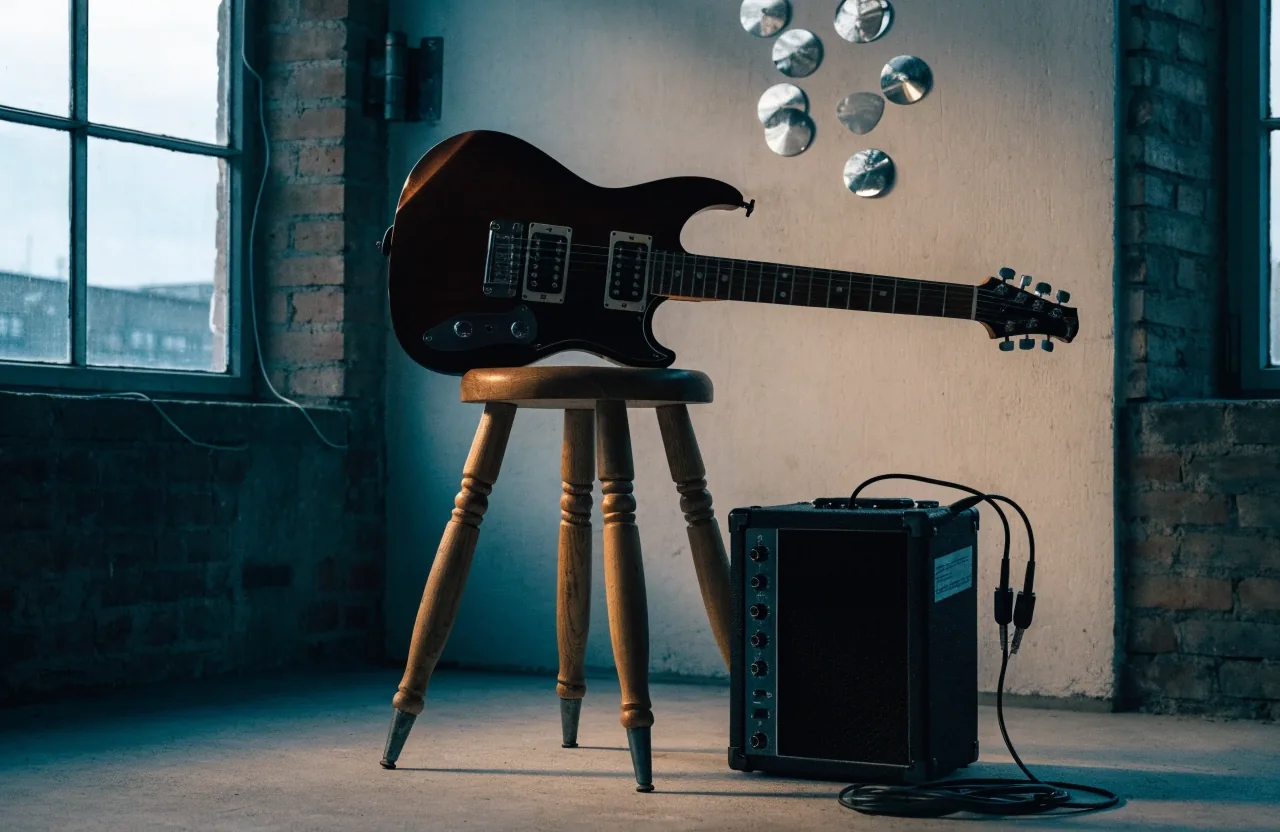
Electric guitars play with lighter string tension and narrower necks, so barre chords and bends arrive sooner. They need an amplifier, though a small practice amp or a headphone setup keeps the neighbours happy. Solid-body electrics feed into rock, blues, funk, and jazz comfortably. If your interest is in riffs and lead playing, an electric gets you there faster than an acoustic will.
Bass guitar
Bass is its own instrument with its own role. You hold down the low end and lock in with the drummer, which means rhythm matters as much as note choice. Beginners often find bass easier to start on because single notes replace chord shapes, but the timing demands are real. Lessons cover fingerstyle and pick technique, root notes, walking lines, and playing in time with a track.
- Root notes and simple lines first
- Fingerstyle and pick covered side by side
- Playing in time with a track as a regular goal

Strumming, fingerpicking, and lead playing
These are three different right-hand skills and they develop separately. Strumming carries most acoustic material and depends on a relaxed wrist and a steady internal pulse. Fingerpicking opens up arpeggios, bass-note patterns, and solo arrangements. Lead playing is about single-note accuracy, bends, and phrasing. Most learners work on one at a time rather than three at once, because the right hand needs repetition to become automatic.
Strumming
Patterns built for the right wrist, with a counting method you can carry to any song.
Fingerpicking
Thumb-and-fingers independence, arpeggio shapes and bass-note patterns for solo arrangements.
Lead playing
Single-note accuracy, clean bends and phrasing — one phrase at a time, slowly at first.
Song tutorials and repertoire
Repertoire is built around the songs you want to play, with the technique needed to play them taught alongside. A song tutorial breaks a track into an intro, verse, chorus, and any distinctive riff, then puts them back together at a tempo you can handle. Tablature is the usual reference for this work because most guitar music is published that way. As you improve, the same song gets revisited at its real speed with the dynamics intact.

Tablature and music reading
Tablature shows you where to put your fingers, string by string, which is why guitarists pick it up quickly. What it does not show well is rhythm, so tab work pairs with counting and listening. Standard notation shows rhythm and pitch clearly and is required for most graded exams. We teach tablature first for most learners and introduce notation when a goal, such as an exam or a reading gig, calls for it.
Tablature
Where the fingers go
String-by-string positions for any riff or chord shape, easy to read off a page or a screen. Rhythm needs to come from counting and from listening to the track.
Standard notation
When rhythm has to be on the page
Note values, key and pitch lined up together. Required for most graded exams, and useful the moment you play with other readers.
Music theory for guitarists
Theory on guitar is practical rather than academic. It answers questions like why certain chords go together, what a key actually means, and how to find a scale shape anywhere on the neck. The CAGED system, intervals, and basic harmony cover most of what a working player needs. Theory is introduced when it solves a problem you have already met, which is why it tends to stick better than memorising rules first.
Most learners meet their first useful piece of theory the same week they meet their first barre chord — it arrives as an answer, not homework.
Styles taught at the studio
Rock, blues, pop, folk, country, and fingerstyle arrangements are all covered, along with the funk and jazz basics that come up in graded syllabuses. Each style brings its own vocabulary: blues bends and shuffle feel, funk sixteenth-note strumming, folk picking patterns. Learners preparing for Rockschool or ABRSM exams work across several styles because both frameworks expect it. Mention the style you are drawn to and the plan will lean that way from the start.
- Blues Bends, shuffle feel and the twelve-bar shape — works on both acoustic and electric, and sounds different on each.
- Rock Power chords, palm muting and riff timing; the natural landing place for anyone who wants lead playing early.
- Funk Sixteenth-note strumming, muting and single-note grooves — sixteenths and grooves come up in graded syllabuses.
- Folk & country Open chords, picking patterns and capo work — the acoustic styles most learners bring to their first enquiry.
- Pop Chord progressions, strumming patterns and arrangement — the fastest route to playing songs you already know.
- Fingerstyle Solo arrangements, alternating thumb and independent treble patterns — usually the second or third style a learner meets.
Style versus instrument
You can play almost any style on either instrument, so let the sound in your head decide. Heavier rock and lead work sit naturally on electric. Fingerstyle arrangements and singer-songwriter material sit naturally on acoustic. Blues works on both and sounds different on each. If you cannot decide, come to a first session and try both before committing to a purchase.

Sits naturally on acoustic
Fingerstyle arrangements, singer-songwriter material and folk picking, all playable without an amp.

Sits naturally on electric
Heavier rock, lead solos and bend-heavy phrasing, with the amp and pedals feeding back into how you play.
Questions before you pick
If your question is not here, put it in the enquiry form in your own words. Answering it is part of working out the plan.
Acoustic or electric for a complete beginner?
Either can work. Electric is gentler on the fingers, which means barre chords and bends arrive sooner. Acoustic needs no amplifier, so any spare ten minutes becomes practice time. What you want to hear matters more than hand strength.
Do I need to already own a guitar to start lessons?
No. Bring nothing to the first session and use the instrument there. That is often the better way to decide between acoustic and electric before you spend money on the wrong one.
Can I learn bass without playing guitar first?
Yes. Bass stands on its own. Single notes replace chord shapes at the start, so the notes come quickly, but the timing work is real and worth taking seriously from the first week.
How soon do learners start on real songs?
Almost immediately. Repertoire is built around the songs you want to play, and the technique that a song needs is taught as part of it. Early versions are often stripped down and played at a comfortable tempo.
Will I have to read standard notation straight away?
No. Tablature comes first for most learners. Notation is introduced when a goal makes it useful, such as a graded exam or a session where everyone reads from the page.

Tell us the two you cannot choose between
Send an enquiry with the instrument and style you are leaning towards, and we will come back with a starting point. The studio replies directly, Monday to Friday 9:00 AM to 6:00 PM and Saturday 10:00 AM to 4:00 PM. You can also call +44 20 7950 7855 or write to [email protected].